Poems & lyrics celebrating Kansas Flint Hills land & people by Annie Wilson – the “Flint Hills Balladeer”
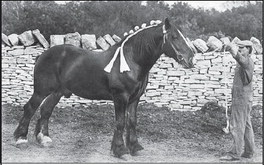
The Best Bloo dlines in America We “will not spare expense, but will look for the best to be had,” claimed L. R. Wiley in a 1910 Kansas Farmer report on his upcoming trip to New York, France & Belgium, to acquire the finest draft horse breeding stock available.
The renowned Wiley family operated a draft horse business west of Elmdale from 1902 to 1924, which they advertised as the “world’s largest importing and breeding establishment of Percherons, Belgians, Shire Stallions and Mares – the best collection in America.”
Of course, travel to Europe in 1910 meant a long ride on an ocean liner – these were the days of the Titanic, returning with large horses on board. The horses were transported across the country by train to Elmdale and then led by hand up the road eight miles to the ranch.
Mr. Wiley and wife Mary E. Wiley were both from well-established families in Colfax, Illinois, and moved to the Flint Hills with two teenage sons, Lon and Roy, drawn by connections with the local Harpole family, also from Illinois.
L. R. was a true risk-taker – borrowed heavily, advertised heavily. Ironically, the obituary of L. R.’s father, a prominent farmer up in Illinois, stated he proudly had never borrowed a penny and didn’t believe in carrying any debt. This was not the practice of his son.
The Wileys strongly promoted the philosophy that better bred horses would lead to more efficient work and greater farm profits, and over the next twenty years they encouraged farmers across the area to purchase and breed better quality work horses.
Think pre-automobile. These were the tractors and trucks of the time. Horsepower was literally “horsepower,” and these breeds were the Cadillacs.
Unfortunately, after tireless efforts in husbandry, marketing, and promotion, the Wileys lost their ranch to foreclosure in 1924.
I always assumed it was conversion to tractors and fossil fuel that hurt them, but have since learned: that transition didn’t happen in this area until later.
An alternative explanation was given by a descendant of the Wileys, who frankly stated: the entire imported registered horse operation was an ill-advised enterprise in this area. He said most farmers around here just could not afford them.
See more stories & songs of the Flint Hills at tallgrassexpress.com