Prohibition In Kansas
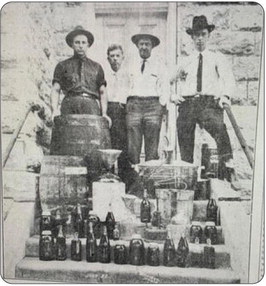
In doing research on events that took place in Greenwood County in the 1920s, one of the almost never-ending articles that appeared in The Eureka Herald was the arrest of one or more individuals for drunkenness or possessing alcohol or the manufacture of alcohol in homemade stills located mostly in rural areas of Greenwood County. Some of the individuals were repeat offenders for one or more of the crimes mentioned above.
The history of Prohibition and the laws which lead to the many arrests that took place in the 1920s, and even before, started early in Kansas history. Kansas became legally dry on May 1, 1881 with an amendment to the state constitution that forever prohibited the manufacture and sale of intoxicating liquors except for medical, scientific and mechanical purposes. Alcohol had to be prescribed by a physician to be obtained legally, and drug stores were made the responsible agency for liquor sales. Druggists could sell liquor only when a doctor’s written prescription was presented along with a sworn affidavit from customers stating that the liquor purchased would not be used as a beverage. Close tabs were kept on the amount that drug stores were receiving and selling as well as to whom they were selling to.
District judges were the only ones with the authority to give out permits for selling liquor. All other places where liquor was manufactured or sold in violation of the law were deemed public nuisances, and offenses were punishable by a fine and 30 to 80 days in jail. Primary responsibility for the law’s enforcement fell to county attorneys, but was made difficult because sales of intoxicants equaled several hundred dollars annually in additional income to pharmacists. Selling for “medicinal purposes” quickly became the largest loophole in the law with physicians prescribing alcohol- laden substances for a wide range of illnesses from colic to diarrhea, and new disease were “invented” for which liquor was the prescribed elixir. Since the term “intoxicating” was not clearly defined, some businesses sold concoctions under names like “cider” claiming to not know that they could be intoxicating. The law was largely ignored.
Many of the state’s drinking spots remained in operation, and underground clubs and saloons also popped up in various places. Some communities and counties across Kansas were content to let them continue operation with minimal fines. Still, many communities believed that the sale of liquor tended to affect them socially, morally and politically. The temperance movement, which had begun in the territorial days of Kansas, gained momentum before the turn of the century with Carrie Nation leading the way. The Hurrel’s Nuisance Bill was enacted in 1901 which specified that all equipment, liquors, and property kept in and used to maintain places where liquor was manufactured, sold, given away or bartered were also common nuisances. The law provided for search and seizure warrants against places where liquor was thought to be sold.
The Kansas Legislature continued to revise and strengthen the statues, and a 1909 revision closed the major loophole in the old law that had allowed druggists to sell liquor for “medicinal purposes.” In 1917, Governor Capper signed a version of the national bone-dry law into effect. The most drastic anti-liquor enactment written at that time made it a crime to possess liquor in any form. The lone exception was communion wine.
With the advent of the first World War, the United States Congress banned the use of food stuffs in the production of distilled liquor from Sept. 1917 until the end of the war in late 1918. This was followed up with the 18th Amendment to the Constitution. The Prohibition Amendment declared the production, transport and sale of intoxicating liquors as illegal, but did not outlaw the actual consumption of alcohol. To enforce prohibition, Congress passed the Volstead Act which went into effect in Jan. 1920. This act was named after Minnesota Representative Andrew Volstead. This act declared an intoxicating beverage to be anything that contained more than 0.5% alcohol, and liquor, wine and beer qualified as intoxicating liquors and were prohibited.
Of course, making liquor illegal did not make it non-existent. Articles in The Eureka Herald and hundreds of other newspapers have stories of moonshine makers, bootleggers and speakeasy bars despite the national, state and local law enforcement officials attempting to enforce the law. On March 22, 1933 President Franklin Roosevelt signed the Beer and Wine Revenue Act. This law levied a federal tax on all alcoholic beverages to raise revenue for the federal government and gave individual states the option to further regulate the sale and distribution of beer and wine. Because Prohibition was still officially the law, a limit had to be placed on the amount of alcohol allowed in beer. Hearings were held, and the political process worked out a standard that could gather the necessary votes-3.2% alcohol by weight. The passage of the 21st Amendment in Dec. 1933 officially ended national prohibition, but Kansas remained dry until 1937 when the state began allowing 3.2% beer. Kansas’ 1881 amendment was tossed out in 1948 when voters rejected prohibition, and the state was placed under a local option law.
In 1949 Kansas upped the age to 21 for drinking anything harder than 3.2% beer and liquor stores were authorized. The open saloon was prohibited forever unless it sold only 3.2% beer. No liquor was allowed in restaurants or open saloons.
Private Club Act (1965) allowed the consumption of liquor on site, but not to the public. A member paid a $10 membership fee, waited 10 days and became a member. Reciprocal memberships were allowed with other private clubs. In 1978 a law was passed that allowed restaurants that sold 50% of their sales in food to also sell liquor to members. In 1978 the “saloon forever prohibited” was ruled unconstitutional. In 1979 open wholesaling was replaced by franchise law.
In 1985 the age to consume 3.2% was raised from 18 to 21. Wallace county is the only county today that you cannot buy liquor by the drink.
( Courtesy photo)